
The Indian government and opposition are preparing for a contentious Monsoon Session of Parliament, with key issues including the Constitution Amendment Bill on delimitation and women's reservation, the alleged NEET paper leak, and a row over Ram temple donations set to spark heated debates.

Two days after a 36-day student agitation concluded at Jantar Mantar, the iconic protest site in New Delhi is already witnessing new demonstrations, including calls for Gorkhaland and women's reservation, alongside curious visitors documenting the aftermath.

'For the rest of his tenure, people will start with the assumption that even Modi can be forced to bow down'
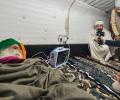
Jagjit Singh Dallewal, a farmer leader, is on an indefinite hunger strike that has entered its 34th day. The Supreme Court has criticized the Punjab government for not shifting Dallewal to a hospital, while farmer leaders have said they are following Gandhian principles and it is up to the government to decide whether to use force to evict him. The farmers are protesting for several demands, including a legal guarantee for a minimum support price (MSP) for crops. The protests have reached a decisive stage, with the SKM (Non-Political) and Kisan Mazdoor Morcha calling for a Punjab bandh on Monday.

At least 50 people were detained as police and paramilitary forces strictly implemented curfew on Thursday in the violence-hit Leh, where four people were killed and over 80 others were injured when widespread clashes broke out a day before.

When dialogue fails, protest becomes inevitable.
In a democracy, protest is often the only language left once institutions stop listening, explains Ramesh Menon.

'Let the world know that India's Gen Z has now moved out of their social media world and is ready to face the lathis, the tear gas shells or the spiked-dandas of cops.'

Ladakh's Lieutenant Governor Kavinder Gupta blamed 'vested interests' for violence that led to four deaths, announcing a curfew and vowing action against those responsible. He cited incitement and conspiracy behind the clashes during a shutdown sponsored by the Leh Apex Body (LAB), which is demanding statehood for Ladakh.

For the first time since curfew was imposed three days ago in violence-hit Leh town of Ladakh, the restrictions were relaxed Saturday afternoon in a phased manner for a few hours, providing relief to residents who lined up outside shops selling essential commodities.

The Leh Apex Body (LAB) is demanding a judicial probe into the recent violence in Leh, which resulted in four deaths and numerous injuries. The LAB co-chairman, Chering Dorjay, denies any foreign involvement and alleges excessive force by police and CRPF personnel.

An uneasy calm prevails in Ladakh as authorities enforce a curfew following clashes between security forces and protesters demanding statehood and constitutional protections. The violence resulted in fatalities and injuries, prompting detentions and political reactions.

Separately, the hunger strike by climate activist Sonam Wangchuk in Leh to "remind" the Bharatiya Janata Party-led Centre of its promise to safeguard the Union Territory's fragile ecology and unique indigenous tribal culture entered its 15th day.
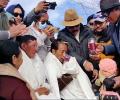
'If the BJP does not change its stand, we will hope that those who are in favour of protecting Ladakh come to power.'

What should have been a direct contest between the Bharatiya Janata Party and the Congress in the Ladakh Lok Sabha constituency is now a three-corner fight with an alliance of local groups fielding an Independent to challenge the national parties.

The LAB leaders said they will continue with their struggle in a peaceful manner through chain hunger strikes and protests.

'Our villagers used to go up to Finger 4 and Finger 6, but today the Chinese are there.' 'Since April 2020, Chinese troops have blocked Indian troops from reaching at least ten patrolling points running from the Depsang plains in the north to Pangong Tso lake in the south.'
